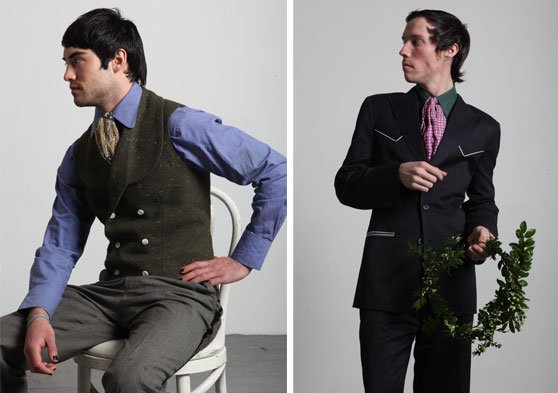
designer Christopher Jones says everyone has their own rock star style.
If the fashion industry breeds eccentricity, then local designer Christopher Jones is the black sheep son that hangs out in the basement, playing Ramones records all night.
Jones’ Seattle-based label, Like a Rock Star, outfits its clientele with stylish, customized suits, which in turn enables them to emulate their favorite rock and roll fashions of the past. Jones, 33, recently sat down with me at Belltown’s Local 360, where we discussed his childhood in Wisconsin, his love of The Stones and why he thinks everyone deserves to be a rock star or at least dress like one.

Seattleite: What came first for you, music or fashion?
Christopher Jones: Music, absolutely. We were the type of kids that didn’t go out too much in high school because my parents would put on The Stones or The Who on a record player for us in the basement. We were late bloomers in that aspect, because we were just nerding out to music. My love for rock and roll was way more developed, and the fashion came directly from that.
S: Where did you grow up?
CJ: Prescott, Wisconsin, population of about 4,000, on the border with Minnesota. Technically, it’s a suburb of Minneapolis, but it’s small-town Wisconsin all the way.
S: How rock & roll was your upbringing?
CJ: Very! My parents definitely encouraged rock music. My best friends growing up also had similar sensibilities. Our parents would pass down the record collection to us. We all had liberal, very open-minded parents that encouraged creativity and listening to music, and we instantly took a shine to it. Once they saw we had an interest in it, and that it was keeping us out of trouble, they encouraged it even more.

S: What was the record that did it?
CJ: Exile on Main Street, absolutely. The Rolling Stones have always been and always will be my favorite band. I just dug into all their records, and still own all the albums I listened to as a kid. They were it for me, from the get-go.
S: What was the rock and roll scene like in Prescott, Wisconsin? Were you able to get to shows?
CJ: Yeah, we went to Minneapolis for that. It took a long time for me to go to shows, because when I was growing up, there was 80s music. I didn’t really relate to modern music that much, and I didn’t like it. I was raised on real, dirty rock and roll. I couldn’t get into what was played on the radio, so I always went back to the classics. So, I didn’t see many shows growing up.
S: How did the grunge phase treat you?
CJ: I wasn’t a big fan, and I’m still not. I like happy, positive energy, and people who like going for their dreams and enjoying it. As opposed to playing music, and rallying against being famous. I embrace these things. I like going up and not down, so I never connected with it, whatsoever. It was only in the 2000s that I got into new music again. Maybe it was just growing older, and I thought I needed to expand my horizons and can’t just keep listening to just the same 50 records that I’ve had for the last 20 years. I always go back to the classics, though. They’re never too far away, at any given moment.

S: How did LaRS come about?
CJ: The whole thing started in college. I was always wearing suits from the late 60s and 70s; after wearing clothes like this for 4-5 years, I had really honed my style. I became an expert in my style, but the downside was that I was always shopping. I was very much a slave to my own style, and I wouldn’t deviate from it. If I found clothes that fit into my own rigid sense of style, I would have to get them altered. Basically, I was wasting hours looking for clothes, and spending money to fix them. One day, I thought, ‘I probably know my style better than the original designers themselves, so I might as well just create my own line.’
S: Did that lead you to study fashion?
CJ: Well, I’m more or less self-taught. I have zero formal training, and the extent of my education is my degree in marketing. At first, I went to a small liberal arts college in Wisconsin. Then, for my sophomore and junior year, I went to the University of Arizona. Basically, I went there because I wanted the opposite experience of my little liberal arts school in Wisconsin, and I got that by going to a humongous university with warm weather. I went back to Wisconsin for my last year, but I made friends in Arizona, and a lot of them were from Los Angeles, so I moved to LA after graduation.
S: What brought you to Seattle?
CJ: I lived in Los Angeles for 4 years, which in retrospect was two years too many. I grew to hate LA. I wanted to stay on the West coast, but I wanted a small big city, so I thought what better place to go? I liked Seattle, I hated LA, so why not? It’s a cool little city, and it had everything I was looking for in terms of arts; music, theater, film, it’s very strong with the things I like, so it was a natural easy fit. I lived in Ballard for my first year, but have been downtown ever since.
S: What’s the creative process for you when a new customer comes in?
CJ: Ultimately, whenever I conceptualize, when I pick up a pen, all I think about is, ‘what do I want to wear today?’ People respond to me dressing myself. They always have, and that’s what gave me the confidence to do it. When I sit down with someone, as is my custom, I get a sense of who they are. Then I ask, ‘if I was this person, what would I like?’ I don’t know any way to do it, other than trying to make myself look good. When I design something, it’s strictly for me, and that’s the only way it could work because I don’t know any other way. People do respond to it positively, though.
S: Not to sound elitist, but if your aim is to dress everyone up in a rock and roll outfit of their own, won’t that diminish the whole ‘rock star’ image?
CJ: I know that it can be very limiting, because what I’m selling is confidence, more or less. The image I want to portray is that I can make even the most basic, cleanest two-piece suit with the rock star aesthetic. It’ll make you stand up a little straighter, and inspire confidence with the people that wear it. It’s definitely a niche market, because not everybody wants that. But for the people that want to get dressed up, it’ll instill rock-star confidence. It’ll look great, but it’s way more of a brand than that. It’s about the mystique, too. Not everybody can be a rock star, but everyone can look good, and I can’t see a downside to a world where everybody dresses up. If everyone in Seattle dressed like a rock star, it would water down the rock star image, but I would love it anyway.

S: What factors into the way you help each customer “find” his/her rock and roll side?
CJ: This is actually my favorite part of the whole deal. If they are local, I’ll meet them in a public place where we’re both comfortable. I take their measurements, and then we break bread, so to speak, by having coffee or a beer. We have a conversation, just two people getting to know each other. It starts from their personality, and I design around that. I ask bleeding questions, like ‘what would you wear?’ in a certain scenario, to get a sense of what they’re comfortable with. It’s all customer service, and I really enjoy talking to people, so once I’ve sat down with someone for 30 minutes, something just clicks.
If they’re not local, we’ll do the same, just over the phone or e-mail. It’s that much better to meet someone in person, because you can shake their hand and do the one-on-one thing, but I’ve had long distance conversations at midnight with people in England. There have been zero instances where I don’t feel like I have made a friend during this process, and I get a sense that they’ll have that much more pride if they think a buddy picked it out.
S: Do people still want to be rock stars in the poor economy?
CJ: Absolutely! More than ever. I’ve been told a zillion times that my prices are too low, but it’s not like I’m pricing my clothes to compete with anyone else, because I stand alone on this sort of deal. I price myself so that people can look good with a little bit of money. If you so desire, you can dress well. I want any server that works two days a week to buy a suit if they want. I set my prices for that exact reason, not to compete. If you want to look good, you can.
S: Of all the old school rockers, who gets the most requests from your customers?
CJ: Probably Jagger, for sure. It’s pretty much Stones and Beatles, in terms of the groups that people reference the most. I get a lot of ‘I saw a photograph of Jagger in 71, and I want the shirt he wore.’ I get a lot of ‘can you recreate this thing that Jimi Hendrix wore at Woodstock?’ I’ll find photographs, and sketch it out. It’s really fun to do reproductions. I always enjoy it.
S: Considering what you do, what is the most unusual request you’ve gotten?
CJ: My friend just requested a suit based on the show Eastbound & Down. It’s a tan suit with silver satin flames on the sleeves and breast and back, with Flama Blanca embroidered in silver on the back. I consulted my tailor and he said we could do it, so I sketched it out and that’s in production right now.

S: Which of today’s rock and roll acts do you think will have the biggest style legacy 30 years from now?
CJ: Just what I’ve seen, the most positive fashion impact I’ve seen is from The Strokes. They made ripped jeans and suit jackets cool again, and got these skuzzy Lower East Side kids wearing loose ties. They’re getting people dressed up, and I was jumping for joy when that stuff got started, especially coming off grunge. They resonated with everybody.
S: Which of today’s bands do you appreciate the most, strictly based on music?
CJ: The White Stripes. I’ve seen Jack White play 15 times now. Most of the modern stuff I listen to is British stuff, like the Libertines. The Black keys are great, too. There’s nothing cooler than seeing kickin’ rock and roll from dudes in suits. So, really, the only modern stuff I like is ‘old school’ sort of stuff. It’s stripped down rock and roll, and it resonates with me. Whether it’s coincidence or not, but bands really strike me when they have a strong sense of style and passion.
S: Too bad about the White Stripes breaking up.
CJ: I’m in mourning. Worse than a death, man.
Not surprisingly, Chris and his team encourage walk-ins, and are always looking for new clients/friends. Like a Rock Star is an online based company. Chris can also be reached at chris@likearockstar.com.
 S E A T T L E I T E