
A shoreside campus where students construct massive wooden vessels from scratch.
Here is a question for those who frequent the waterfront: have you ever wondered how the wooden boats are built, or who builds them? No, not the canoe waiting to be sanded on a couple of sawhorses in your garage — large-scale seagoing vessels from industry innovators like Nathanael Herreshoff, Chris-Craft and Howard Chappelle.

At the Northwest Boat School (NWBS), located in the coastal town of Port Hadlock, students learn how to construct these aesthetically-striking wooden giants from scratch. Instructor Tim Lee, Chief Instructor at NWBS with an 11-year tenure, explained that students gain skills in a multitude of areas when they attend classes at the school.
“The school is a total immersion experience in boat building,” Lee said. “At the end of the year, the motivated student should be able to function and contribute to a professional shop, build a boat on their own or take care of a wooden boat.”
“At the very least,” he added, “I hope that the student learns how to make things on their own and learns to appreciate and support the skilled trades.”
Lee claims that people from many different walks of life are drawn to the school. Young people trying to learn a trade, college graduates hoping to establish a career and adults and retired professionals who have dreamed of building boats for years — all of these (and more) are represented on the roster.
“[All of these people] are the ones who really come to foster the school and appreciate its uniqueness,” Lee said. He claimed the school currently has 56 registered students.
One student, Chris Erikson, has been enrolled for the past six months. He said the first quarter is devoted to mastering the fundamentals of woodworking. “You make your own tools and toolboxes,” Erikson said of the first term. “You [also] learn joinery and other aspects of woodworking, as well as drafting.”
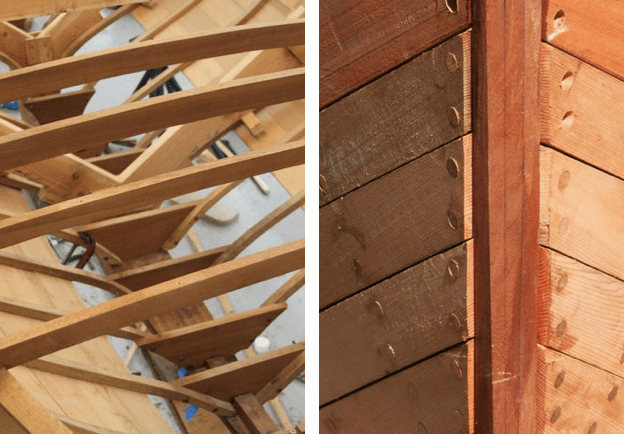
Once the rudimentary knowledge has been absorbed, students choose between three disciplines of boat-building: traditional small craft, traditional large craft and contemporary. Erikson explained that the main difference is the fastening agent; traditional techniques only utilize glue, whereas contemporary designs incorporate both glues and other materials, such as epoxies and fiberglass.
Once a year’s education has been completed, the student is awarded an Associate’s degree of Occupational Studies. Lee said that former students have gone onto a wide range of careers.
“We have students working in maritime museums, custom home building, furniture design, sailing, yacht design, instruments [and teaching],” he said. “Once you learn to use your hands and make things, your imagination is the limit.”
Visit the school online official Web site for more information about these unique curriculum programs. Web users can also obtain information about boats made by NWBS alumni that are for sale or to learn more about upcoming summer activities, such as sailing/rowing tutorials, welding workshops and skiff-building projects.
 S E A T T L E I T E