 Out of the Furnace is not the movie you expect, it’s not quite the movie you think you want, and it’s certainly not a movie you’ll see coming, but it is one of the best movies of 2013. Petering along a solemn road of America as industrialized hellhole, the jet-black tone and snail’s pace cadence of the film may prove too overbearing for some but those willing to dive into the mire will find a film overflowing with themes of chaotic grace, personal sacrifice, ego death, spiritual deterioration, and unbounded duty. Many similarities to early Kurosawa samurai films and Drive – which itself is largely plotted like a samurai film – emerge and make the film rich with subtext, even though unearthing that subtext is a bit of a harrowing chore.
Author: Matt Oakes

Continuing a tradition of excellence, Nebraska is Alexander Payne‘s seventh film in 22 years and has all the earmarks of a Payne project. But behind the landmarks that we’ve come to expect from an Alexander Payne film is a script boiling from the page, courtesy of Seattle native Bob Nelson. Perfectly blending melancholic drama and high comedy, Nelson writes Nebraska from his life experiences, here seen through the lens of a middle class family trying to rediscover their pride on a Midwest road trip.
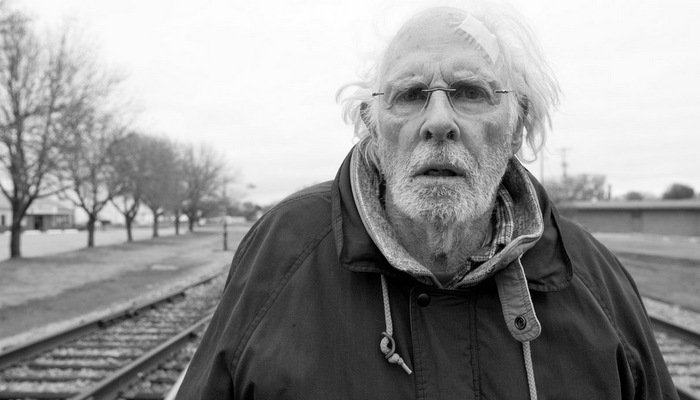 Nebraska starts with the old school painted mountains of the Paramount logo, a veiled reminder of the golden days of the USA, and jumps into an austere black-and-white landscape of Montana as Bruce Dern‘s Woody Grant stumbles down the snowy strip of government manicured grass between some train tracks and a largely vacant highway. Convinced he has won a million dollar prize, Woody’s intent on claiming his winnings in Nebraska even if that means walking the entire eight hundred mile trip on foot. A reminder of how off the tracks his life has veered, Woody sees his not-too-good-to-be-true grand prize as a means to a life he never had – a golden ticket to meaningfulness and utility long lost.
 Katniss Everdeen may be the girl on fire and Jennifer Lawrence may be Hollywood hot stuff (du jour), but this second installment of The Hunger Games is only slightly smoldering. In fact, the embers have already started to go cold. All the requisite franchise pieces are there to stoke the billion dollar conflagration this dystopian blockbuster is sure to light, but the overwhelming feeling that there is little spark behind the bark leaves us chilled to all this talk of fire.
 Kill Your Darlings provides an origin story for some of the most prolific authors writing this side of the American Renaissance with a bit of a hot-blooded, cold-fingered approach. A burning sense of urgency ignites the passion of the characters onscreen – coiled up and bouncing off the walls, lunatics as they are – but that same urgency is largely absent from the film itself.

Imagine being sat down and told that you’ve just tested positive for HIV. Now imagine that you’ve only ever been told that this is a “gay disease” – an impossible horror reserved only for the darkest corner of “queerness.” Then picture this whopper: you’ve got six weeks to live. Six weeks. 42 days. 1000 hours…and that’s not accounting for time spent sleeping. The rest of your life needs to fit within the confines of a 1000-hour window. Welcome to AIDS in the 80s.

Ender, a natural born strategist, waxes philosophy like he’s Sun Tzu. Taking “The Art of War” to its next logical step, Ender believes it’s not enough to understand his enemy. For him, truly understanding your enemy comes hand-in-hand with loving them. When you know someone well enough to predict their moves militarily, you glimpse into their soul. All at once, this zen of inter-connectivity gives Ender an upper hand in battle but also puts him in a constantly state of moral dread. He knows he can be a mighty conqueror the likes of Caesar but doesn’t know if he should be.
 When we think Ridley Scott, typically big, lavish spectacles pop up in our minds, which is why The Counselor comes as such an admirable surprise. Much more interested in cautionary talks than fits of physical violence, The Counselor plays mind games with its audience, toying with us intellectually and emotionally.
2013 is the year of the survivor-thriller living on top. In Gravity, Alfonso Cuarón explored themes of isolation amidst the inhospitable vacuum of space, using dazzling special effects to elevate a simple story to a visual masterpiece. Paul Greengrass dove into the true account of Richard Phillips and his struggle to maintain

Wadjda is first and foremost an important film. More than just the first movie ever filmed in Saudi Arabia – where cinema has been illegal under censorship laws since the 1980s – and the first feature film ever from a female Saudi Arabian director, Wadjda is actually quite a good film. Director Haifaa Al-Mansour braves the rocky shoals of creating a slyly counterculture work in a totalitarian
 S E A T T L E I T E